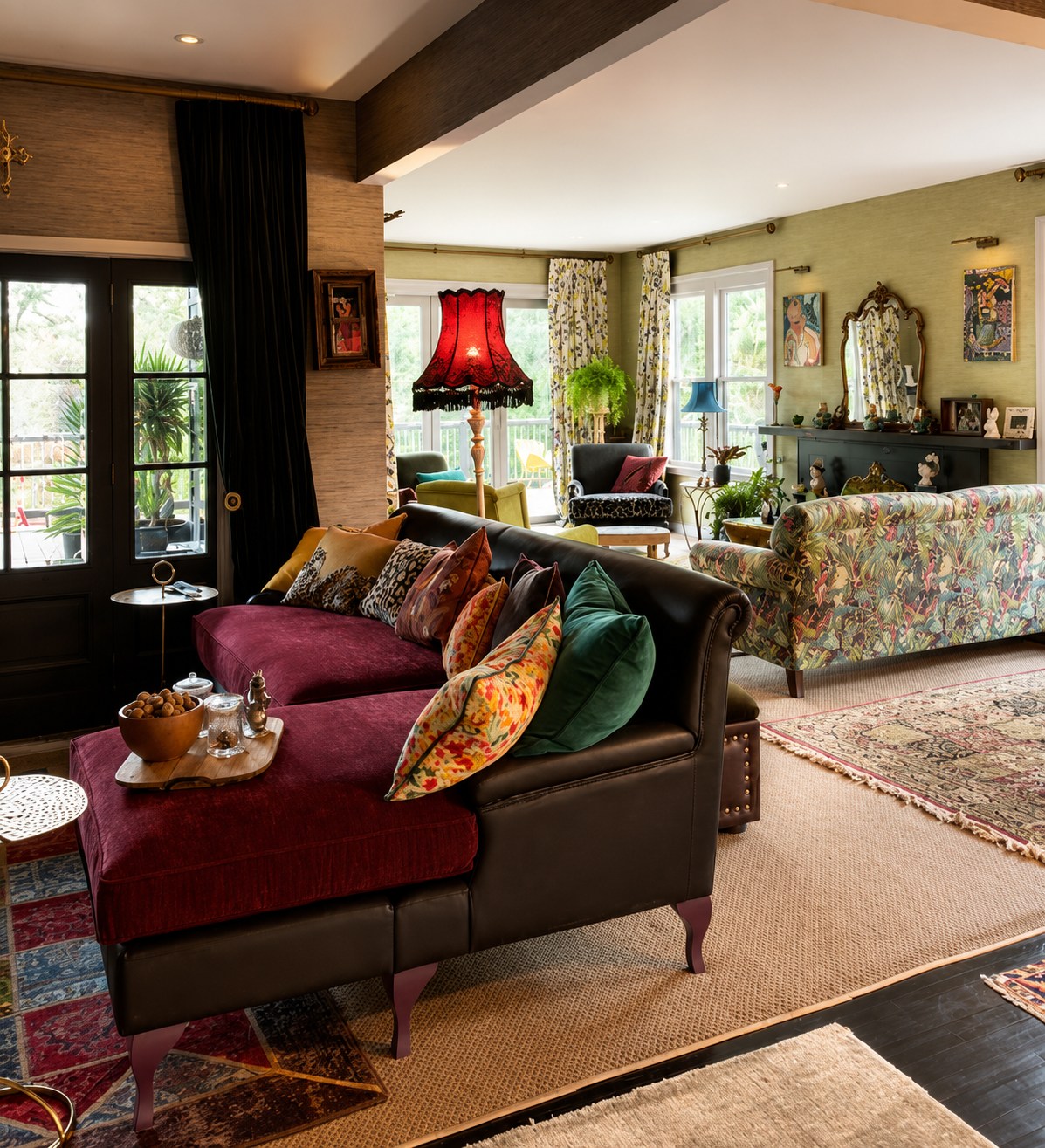
The design rules worth knowing are few and simple: the 60-30-10 colour split, layered lighting, scale and proportion, and roughly 80% timeless to 20% trend. I use all of them, mostly by instinct after a career of it, and there is one I break on purpose.
Rules like these are a starting point, not a cage. They are useful precisely because you can learn them quickly, and they'll keep a room from going badly wrong. Knowing when to set one aside is the part that takes longer.
The 60-30-10 colour rule
The simplest one, and the most useful. Give roughly 60% of a room to a dominant colour, usually the walls and large furniture, 30% to a secondary colour in upholstery and drapery, and 10% to an accent in the smaller pieces and details. It gives a scheme balance without going flat, and it's an easy check when a room feels off: usually one of those proportions has crept out of line.
Layer your lighting
One overhead light will never make a room feel good. You want three layers working together: ambient light for the general glow, task light where you actually do things, and accent light to pick out the pieces worth looking at. Get all three, on separate switches, and a room can change character from morning to evening.
Scale, proportion and the golden ratio
Most rooms that feel wrong feel wrong because of scale, not colour. Furniture too small for a big room looks lost; furniture too big for a small one is worse. The old idea of the golden ratio is really just a reminder to keep the relationships between things pleasing, so nothing fights for attention it shouldn't have.
I always work to about 80% timeless and 20% trend. It's kind of instinctive now, but it's the ratio that keeps a room from dating.
The rule I break
Designers are taught to style in odd numbers: group things in threes and fives, never pairs. It's good advice and I follow it most of the time. But I break it often, quite deliberately, to create visual balance for a client whose room has an issue with structure, where a symmetrical pair does the job a trio can't. That's the difference experience makes. You learn the rules so well that you can feel exactly when a room is asking you to ignore one.